
If you’ve used an AI chat to talk through something difficult, the ground just shifted. Several US states now require these tools to say plainly that they aren’t human, to notice when someone is in crisis, and to hand over real help rather than keep talking. It’s a low bar. It’s also long overdue.
You don’t need to follow the legislation to benefit from it. What matters is knowing what a decent AI assistant should do for you, and what it should never pretend to be.
Why lawmakers moved on AI mental health chat
People talk to AI about things they won’t say to anyone else. That’s not a flaw in the users. A chat window is available at three in the morning, it doesn’t look tired, and it never knows your family. For a lot of people that’s the first place a hard thought gets said out loud.
The trouble is what happens next. An assistant that’s been tuned to be agreeable will agree. One that’s been built to keep you engaged will keep you there. Neither instinct is what you need when the conversation turns towards self-harm, and regulators watched enough of those conversations go wrong to start writing rules.
What the new rules actually require
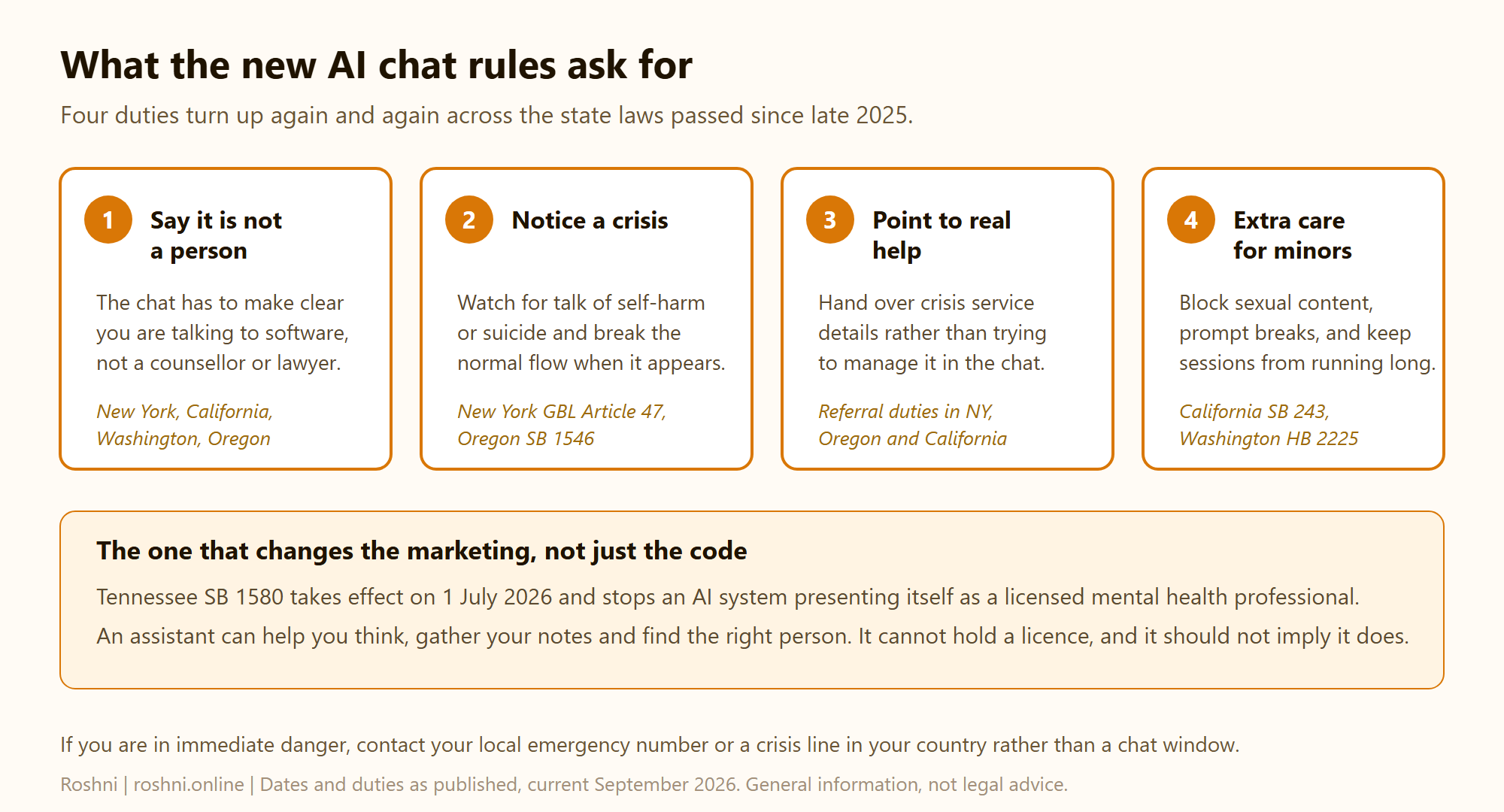
Four duties show up again and again across the laws passed since late 2025.
Say it isn’t a person. New York’s rules for AI companion models took effect on 5 November 2025. California’s SB 243 followed on 1 January 2026. Washington and Oregon have their own versions arriving in 2027. All of them land on the same first requirement: the chat has to make clear you’re talking to software.
Notice a crisis. New York’s law and Oregon’s SB 1546 both expect the system to detect talk of suicide or self-harm and break the normal flow when it appears. Not to counsel. To stop and change course.
Point to real help. Detection without referral is useless, so the same laws attach a duty to surface crisis service details rather than manage the situation inside the chat.
Take extra care with minors. California’s SB 243 and Washington’s HB 2225 add protections for younger users, including blocking sexual content and prompting breaks so sessions don’t run on indefinitely.
Oregon attached a figure to getting it wrong: $1,000 per violation, with a private right of action. Nebraska’s LB 525 and Idaho’s SB 1297 follow in July 2027.
The rule that changes what these tools can call themselves
Tennessee’s SB 1580 takes effect on 1 July 2026 and stops an AI system presenting itself as a licensed mental health professional. That one deserves more attention than it’s had.
An assistant can help you order your thoughts before a session. It can help you work out whether what you’re dealing with is a mental health question or a legal one, which is less obvious than it sounds when a situation involves both. It can sit with you at an hour when nothing else is open. What it cannot do is hold a licence, carry professional accountability, or take responsibility for your care. Any product implying otherwise is selling you something it doesn’t have.
What a good AI assistant should never do
Three behaviours are worth walking away from, whatever the law says.
It shouldn’t diagnose you. An assistant that hands you a condition name after nine messages is guessing, and a wrong label can stick for years.
It shouldn’t discourage you from seeking a person. If suggesting a professional makes the product look worse, the product is built wrong.
It shouldn’t blur into your private records. An assistant you’re using to think out loud should be separate from the conversation you have with a professional, so that thinking out loud stays exactly that.
How the assistant on Roshni is set up
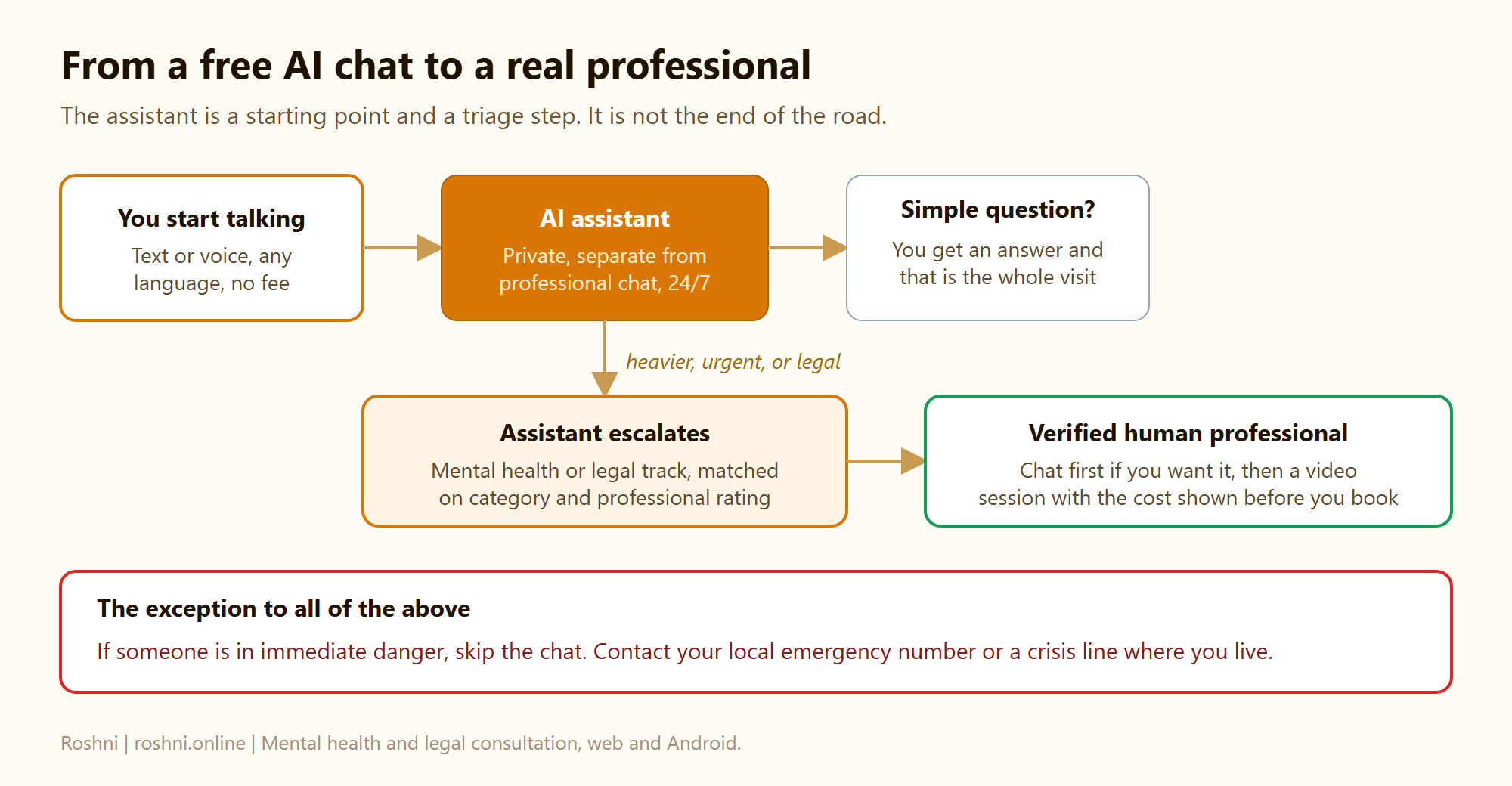
The free assistant on Roshni is deliberately built as a starting point rather than a destination. It’s clearly an assistant, not a counsellor and not a lawyer. It works in text or voice, in any language you prefer, and it’s available around the clock. The conversation is private and kept separate from the chat you have with a professional.
When something needs a person, it says so and hands you over. Roshni runs two tracks, mental health and legal, and the handover matches you to a verified professional by category and rating. You can chat first if that’s easier, then move to a video session, and the cost is shown before you book anything. The walkthrough of how the client application works covers the full sequence if you want to see it before signing up.
When to stop chatting and ask for a human
There’s no clean test, but a few signals are reliable enough to act on.
Ask for a person when the same problem keeps coming back no matter how many times you talk it through. Circling is a sign you need someone who can hold the thread across weeks, not a fresh conversation each time.
Ask when the situation involves anyone else’s safety, or when a decision carries legal weight. An assistant can help you understand a document. It can’t advise you on what to sign.
And ask when you notice you’re using the chat to avoid something rather than work on it. That one’s harder to spot from the inside, which is part of why the handover exists.
If someone is in immediate danger, skip all of this. Contact your local emergency number or a crisis line where you live. A chat window is the wrong tool for an emergency and no law has changed that.
What this means if you’re choosing a service
The rules give you a checklist you can apply in about a minute. Does it tell you it’s AI without being asked? Does it react when you mention harming yourself, or does it carry on as though you’d mentioned the weather? Can you reach a real professional from inside it, and is the price visible before you commit?
A service that clears all four is being run by people who thought about this before a statute made them. One that fails the first question isn’t worth the second.
Worth saying plainly: this article is general information about published rules as they stand in September 2026, not legal or medical advice. The laws differ in scope and several are new enough to be untested.
Frequently asked questions
Is an AI mental health chat confidential?
It depends entirely on the service, so check before you type anything sensitive. On Roshni the assistant conversation is private and held separately from your professional consultations. Read the privacy terms of any tool you use, because confidentiality practices vary far more than the marketing suggests.
Can an AI assistant replace therapy?
No, and Tennessee’s SB 1580 will stop AI systems from even presenting themselves as licensed professionals from July 2026. An assistant is useful for thinking something through, preparing for a session, or working out who you need. Care is a relationship with a qualified person.
Do these rules apply outside the United States?
These particular laws are US state laws. Other regions are moving on similar ground, and the EU AI Act carries its own transparency duties for systems that interact with people. Roshni is available internationally, and the standards described here are how we think the service should behave regardless of where you are.
What happens when I ask the assistant for a real person?
You’re matched with a verified professional on either the mental health or the legal track, based on category and rating. You can start with chat and move to a video session. Session cost appears before you book, and the pricing page lists what each option includes.
Is the AI assistant free?
Yes. Text and voice conversations with the assistant cost nothing, in any language. You only pay when you book time with a human professional.
Related resources
- Start a free conversation with the assistant
- How the Roshni client application works
- Client application guide
- Pricing and session options
- About Roshni
Talk it through, then decide
If something has been sitting with you and you’re not sure whether it needs a counsellor, a lawyer, or just an hour of honest thinking, the assistant is a reasonable place to start and it costs nothing. When it turns out you need a person, it will tell you so and connect you to one.
Recent Comments