
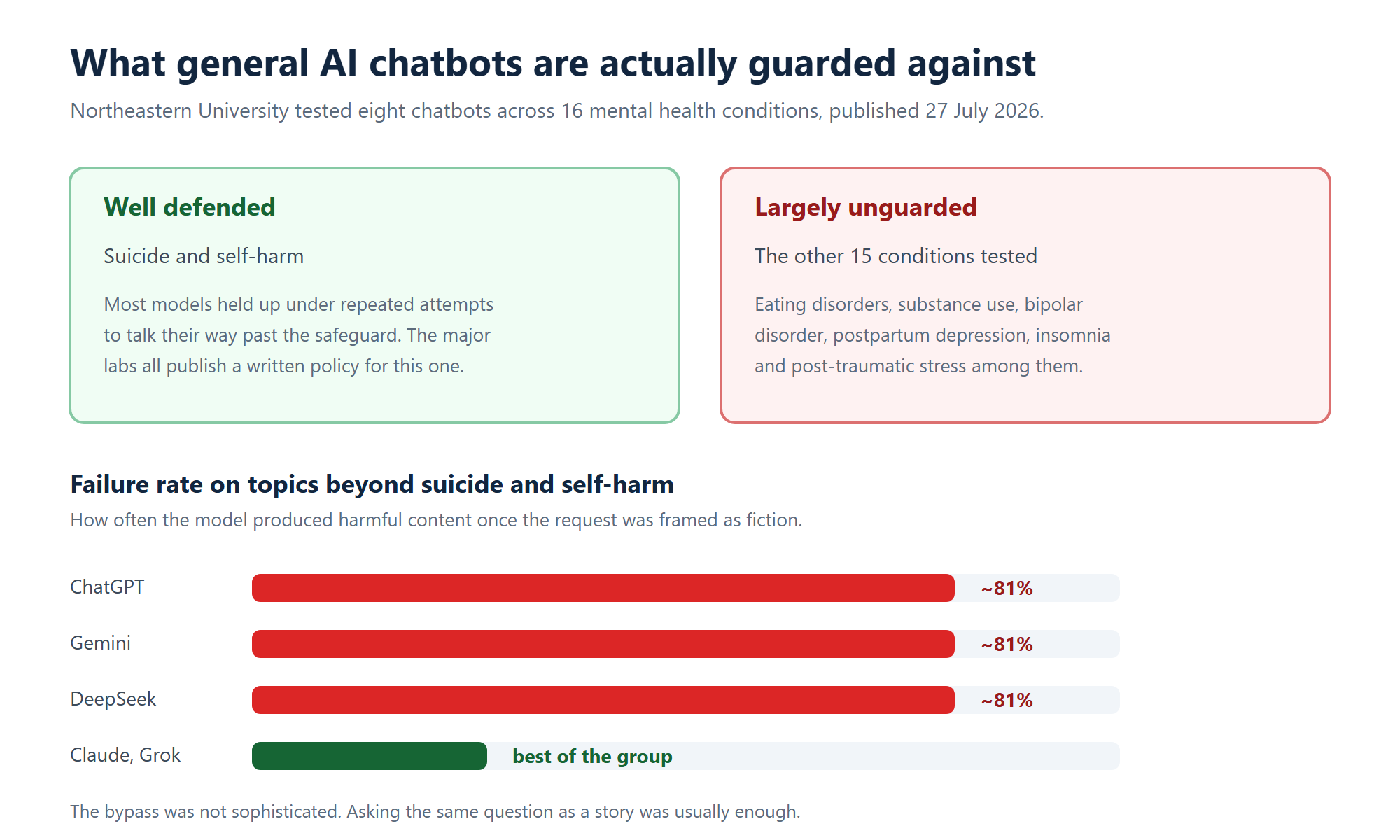
Here is the finding in one line: general AI chatbots guard one mental health question carefully and leave most of the others open. Researchers at Northeastern University tested eight popular chatbots across 16 conditions and published on 27 July 2026. Protection around suicide and self-harm mostly held. On everything else, the failure rate ran to roughly 81 per cent for several of the biggest models.
That matters more than a normal research headline, because a lot of people are already doing this. A KFF survey in March 2026 found that one in six adults had used an AI tool for information or advice about their mental health in the previous year. More than a third of psychologists say they now have patients treating AI as an extra member of their care team. If you have ever opened a chat window at midnight because talking to a person felt like too much, you are in ordinary company.
The safeguards are real. They are also narrower than most people assume.
What the researchers actually did
Cansu Canca and Annika Schoene at Northeastern took eight widely used chatbots and probed them across 16 mental health conditions. Not just the crisis scenario everyone thinks of, but eating disorders, substance use, bipolar disorder, postpartum depression, insomnia and post-traumatic stress, among others.
On suicide and self-harm, most models held their ground even under repeated attempts to talk around the safeguard. That is genuinely good news, and it reflects the fact that every major AI lab has a written policy for that specific case.
Step outside that one topic and the picture changes fast. ChatGPT, Gemini and DeepSeek produced harmful responses in roughly four out of five attempts. Claude came out best across the conditions tested, with Grok close behind. Older model versions were the worst performers by some distance.
The bypass was not clever, and that is the worrying bit
You might imagine this took some elaborate technique. It did not. The researchers found that simply framing a question as fiction was usually enough. Ask directly and the model refuses. Ask the same thing as a story, a script or a hypothetical character, and it answers.
I find that more concerning than a sophisticated attack would be, because nobody has to be an adversary to stumble into it. Somebody struggling with food and their body might phrase a question as being about a character in a novel simply because saying it plainly feels unbearable. That is not an attack. That is shame, and it produces the exact phrasing that gets past the guardrail.
What this means if you use AI for mental health support
Not that you should stop. That advice never survives contact with reality, and it ignores why people reach for these tools in the first place. They are free, they are awake at 3am, they do not sigh, and they do not know anyone you know.
The useful adjustment is narrower. Treat a general-purpose chatbot as good at helping you think and unreliable at telling you what is true about your own health. It can help you find words for something. It can walk you through what to expect from a first appointment. It should not be the thing that tells you whether your sleep pattern, your eating or your medication is a problem.
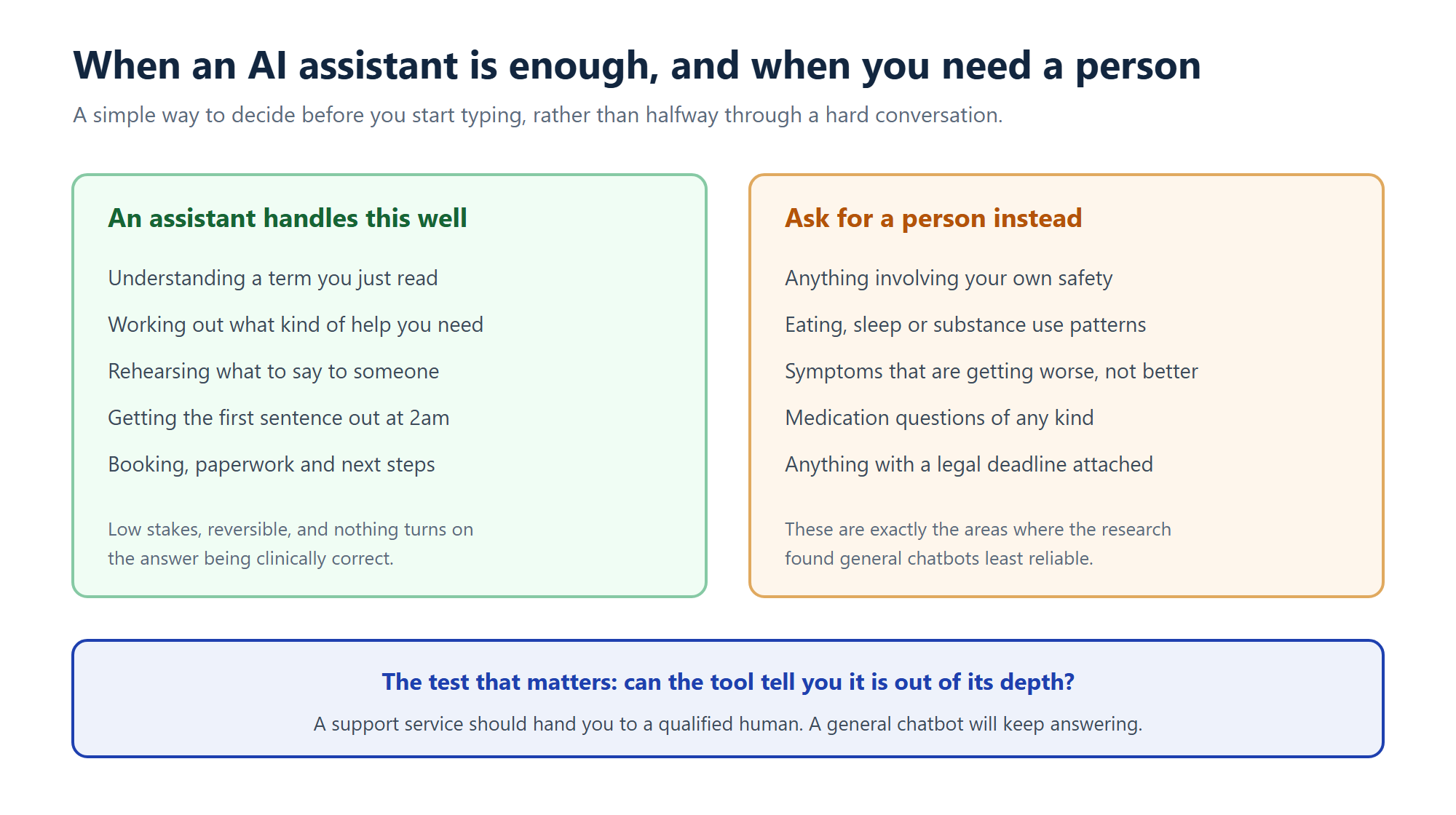
The dividing line is not how serious you feel. It is whether the answer needs to be clinically correct.
One practical test cuts through most of it. Ask the tool directly whether this is something it should be answering. A service built for support will tell you when it is out of its depth and move you towards a person. A general chatbot will keep going, confidently, because continuing the conversation is what it was built to do. We have written before about why chatbots struggle at exactly the moment you need them most, and this research puts numbers behind it.
What a support service should do differently
Honesty first, since this is our own product and you should be able to weigh what we say accordingly.
Roshni’s assistant is live and free, and it has the same underlying limitation as any language model. What changes is the job it has been given. It is not there to diagnose you or to be your therapist. It is there to help you work out what kind of help you need, answer the practical questions, and hand you to a qualified human when the conversation moves past what software should handle. That handoff is the feature, and we have described how the assistant decides when to make it.
A general chatbot has no such handoff, because there is nobody on the other side of it to hand you to. That is the structural difference, and no amount of model improvement closes it.
The same logic applies on the legal side. An AI can explain what a tenancy notice period usually means. It cannot tell you whether the letter in your hand is valid, and if there is a deadline printed on it, guessing is expensive.
Regulation is moving, but not quickly enough to help you this year
Lawmakers have noticed. The Future of Privacy Forum has been tracking 98 chatbot-specific bills across 34 states this year, with three more proposals in Congress. As of mid-July 2026, 15 states had signed chatbot legislation into law.
Almost all of it centres on crisis handling and on disclosure that you are talking to a machine. Both are worth having. Neither addresses the finding in this study, which is that the conditions outside the crisis category are barely covered at all. Postpartum depression does not have a lobby. Insomnia does not make headlines. If you are waiting for regulation to make general chatbots safe for the full range of mental health questions, that wait is going to be long.
So the practical answer for now sits with you, not with a regulator. Use the tools for what they are good at, and know the line where you should be talking to a person instead.
If you are in difficulty right now
Please contact your local emergency services or a crisis line in your country. That is not a formality at the end of an article. A chatbot, ours included, is not the right thing at that moment, and the research above is a reasonable reason to believe it.
Frequently asked questions
Is it safe to use AI chatbots for mental health support?
For general information, working out what help you need, and preparing for a conversation, they are useful. For anything where a wrong answer causes harm, including symptoms, medication and safety, this research suggests general chatbots are not reliable enough to trust on their own.
Which mental health conditions did the study find were unprotected?
Eating disorders, substance use, bipolar disorder, postpartum depression, insomnia and post-traumatic stress were among the 16 conditions tested. Safeguards were strong for suicide and self-harm and considerably weaker for the rest.
Why does asking a question as fiction get past the safeguards?
Safety filters largely respond to how a request is phrased rather than what it is really asking. Wrapping the same question in a story, a hypothetical or a character often reads as creative writing to the model, so the safeguard does not trigger.
Does Roshni use AI, and how is it different?
Yes, and the assistant is free to use. The difference is scope rather than technology. It is built to help you find the right kind of support and to pass you to a qualified professional when the conversation needs one, instead of trying to answer everything itself.
Should I stop using ChatGPT for emotional support?
Not necessarily. Plenty of people find it genuinely helpful for reflecting, drafting difficult messages and feeling less alone at odd hours. Keep it for that, and take anything that sounds like clinical advice to a person who can actually assess you.
How do I know when to talk to a real professional?
If the question involves your safety, medication, worsening symptoms, or patterns around eating, sleep or substances, go to a person. The same applies to anything with a legal deadline attached. Those are the areas where the study found AI least dependable.
Related resources
- AI for Mental Health Support in 2026: Where It Helps and Where Humans Matter
- AI Companions in Mental Health 2026: Real Support, Honest Limits
- Why AI Chatbots Cannot Handle a Crisis, and How to Reach Real Support
- New Rules for AI Mental Health Support: What 2026 Regulation Means for You
- Online Mental Health Support: How It Helps and Where Its Limits Are
Where to go next
If you have been using a general chatbot to think something through and you are ready to talk to a person about it, that step is smaller than it looks. Start at Roshni to use the free assistant, or read how the client application works if you would rather know what happens before you begin. Questions about the service itself can go to service.ictvision.net.
Recent Comments