
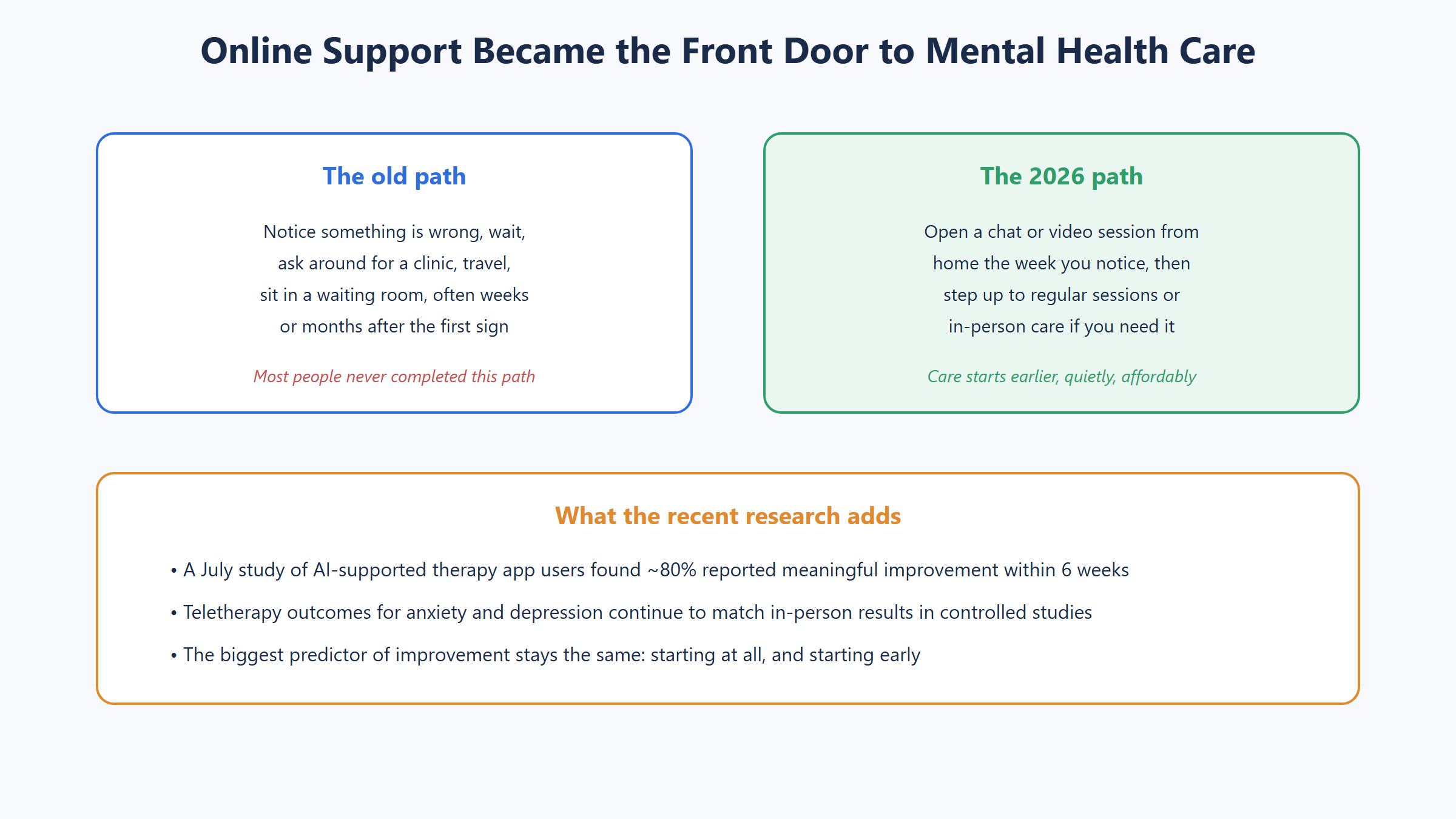
For decades, getting mental health support started with the hardest possible step: telling someone face to face. Find a clinic, travel there, sit in a waiting room where a neighbor might see you. Research published this month adds to a picture that’s been forming for a while now: that path has been replaced. A study of people using AI-supported therapy apps found roughly 80% reported meaningful improvement within six weeks. Teletherapy keeps matching in-person outcomes for anxiety and depression in controlled comparisons. The front door to care has moved online, and the evidence says the new door works.
Why Starting Early Beats Starting Perfectly
Buried in most outcome studies is a finding that doesn’t get headlines: the strongest predictor of improvement isn’t which therapy modality you pick. It’s whether you start, and how early. Anxiety and low mood respond far better in their first months than after years of quiet compounding, when they’ve had time to reshape sleep, work, and relationships.
The old path failed precisely on this measure. Every barrier, distance, cost, the fear of being seen, pushed the start date later, and for most people it pushed it to never. What online support changed isn’t the therapy itself. It’s the start date. A first conversation the same week you notice something is wrong, from your own room, with nobody watching you walk in.
That’s also the honest way to read the 80%-in-six-weeks result. It isn’t evidence that an app replaces a therapist. It’s evidence that accessible, structured support, available at the exact moment someone is ready to reach for it, moves the needle for most people who use it.
Stepped Care: The Structure Behind the Numbers
The systems getting good results share a shape that clinicians call stepped care: start with the lightest support that could help, and step up only when needed.
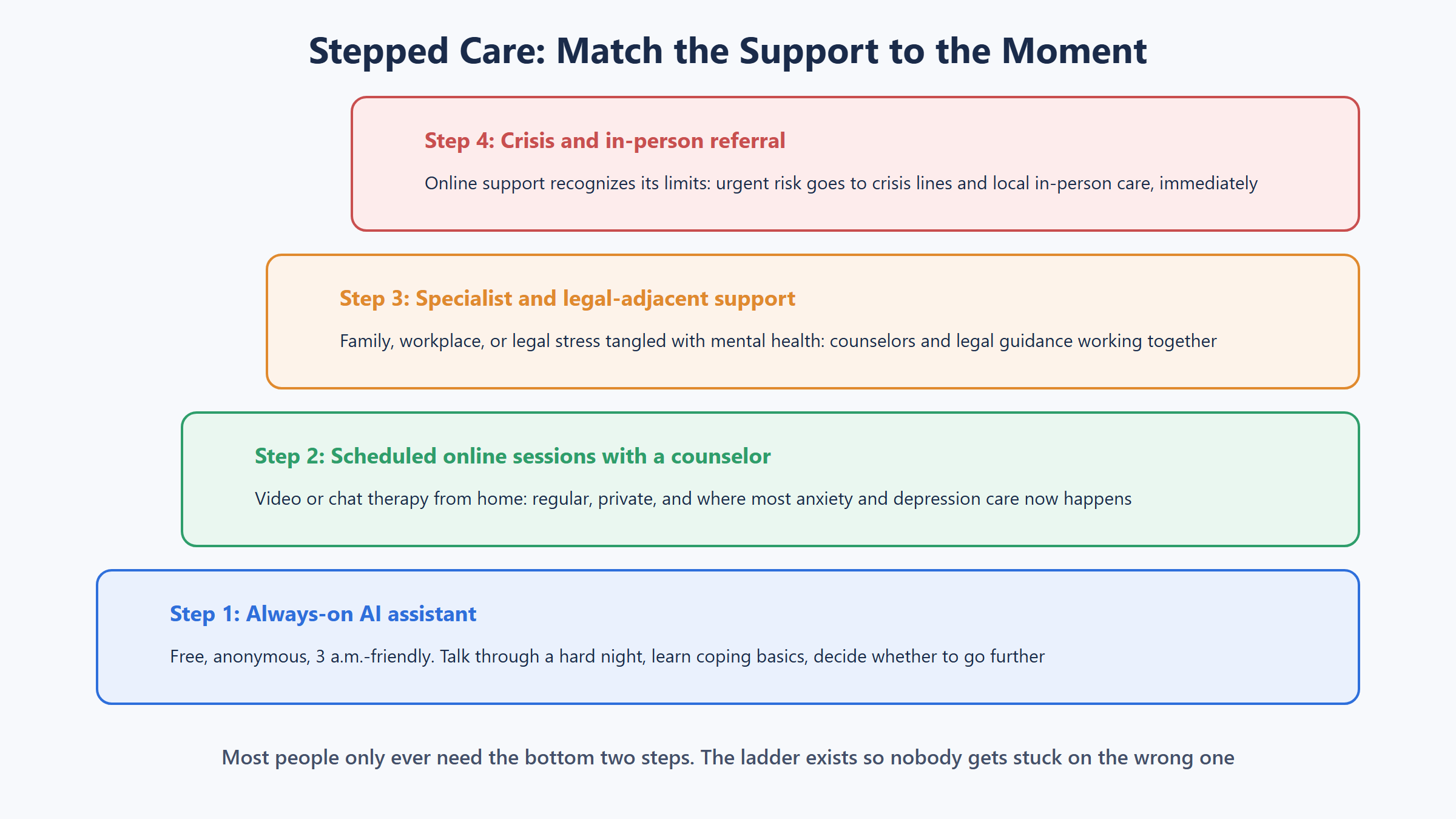
The first step is an always-available assistant. Roshni’s free AI assistant exists for exactly this rung: it’s anonymous, it’s awake at 3 a.m. when the hard thoughts are loudest, and it helps you talk through what’s happening and decide whether you want more. We’ve written before about what AI chat support can and can’t do, and the boundary matters: it’s a starting point and a bridge, not a replacement for human care.
The second step is scheduled sessions with a counselor, by video or chat, and this is where most anxiety and depression care now happens. The research comparing it to in-person therapy keeps landing in the same place: for common conditions, outcomes match. Our guide to how online mental health support helps walks through what those sessions actually look like.
The third step recognizes something the neat clinical categories miss: a lot of distress arrives tangled with practical problems. A marriage under strain, workplace harassment, an inheritance dispute eating a family alive. Talking to a counselor helps; sometimes you also need to know your options. That’s why Roshni pairs mental health support with online legal consultation, because the anxiety and the legal question are often the same problem wearing two coats.
The fourth step is the one any honest platform has to name: crisis. Online support has limits, and urgent risk belongs with crisis lines and local in-person care immediately, not with an app. A system that doesn’t say this clearly isn’t a care system; it’s a product hoping nothing goes wrong.
What This Means If You’ve Been Waiting
If you’ve been circling the idea of getting support, the research this month is really about you. The tools at the bottom of the ladder are free or close to it, they’re private, and the evidence says most people who engage with them feel meaningfully better within weeks. You don’t have to commit to therapy to start. You have to start to find out whether therapy is what you need.
Open a conversation with the assistant tonight if tonight is hard. Book a session if the conversation tells you there’s more to work through. The session options are built to be a smaller obstacle than the problem you’re carrying. The front door moved. It’s closer than it has ever been.
FAQ
Does online therapy actually work as well as in-person?
For the most common concerns, anxiety and depression, controlled studies keep finding comparable outcomes between video-based therapy and in-person sessions. What matters most is starting early and attending consistently, both of which online formats make easier.
What did the new AI therapy research find?
A study published this month of people using AI-supported therapy apps found around 80% reported meaningful improvement within six weeks. The result reflects accessible, structured support reaching people early, not AI replacing human therapists.
Is an AI assistant a substitute for a counselor?
No. It’s a first step: a private space to put what you’re feeling into words, learn coping basics, and decide whether to book a human session. Anything involving urgent risk, or persistent symptoms, belongs with a counselor or crisis service.
What is stepped care?
A way of organizing support so you start with the lightest effective help, an always-on assistant or self-guided tools, and step up to scheduled counseling, specialist support, or in-person care only as needed. It keeps early help cheap and immediate while keeping serious care available.
When should someone skip the app and seek immediate help?
If there are thoughts of self-harm, harm to others, or a safety risk at home, contact a crisis line or local emergency services right away. Online platforms, including this one, are built for support and early care, not emergencies.
Recent Comments