
If you’ve been feeling flat rather than sad, getting through the days without much energy or spark, you’re far from alone. A new study of 53,799 people in 92 countries found “languishing” mental health across many groups, especially younger adults. It isn’t a diagnosis, but it’s worth taking seriously, and the right mental health support depends on where you are.
The study, called Global Mental Wealth, was published online in the journal Social Indicators Research on 30 October 2026. It was led by Kai Ruggeri of Columbia University’s Mailman School of Public Health, with 261 co-authors, and Columbia announced it on 2 November. Here’s what it found, what it can’t tell you, and what you can do if some of it sounds familiar.
What the study found
The researchers asked people about their mental health across several dimensions, including competence, optimism, self-esteem, positive emotion, engagement and vitality. They also asked about stress, depression, anxiety, life satisfaction, and financial and social wellbeing.
In the authors’ words, the findings include “a trend of languishing mental health across many groups, particularly among younger adults and within higher-income countries.” A few details stand out:
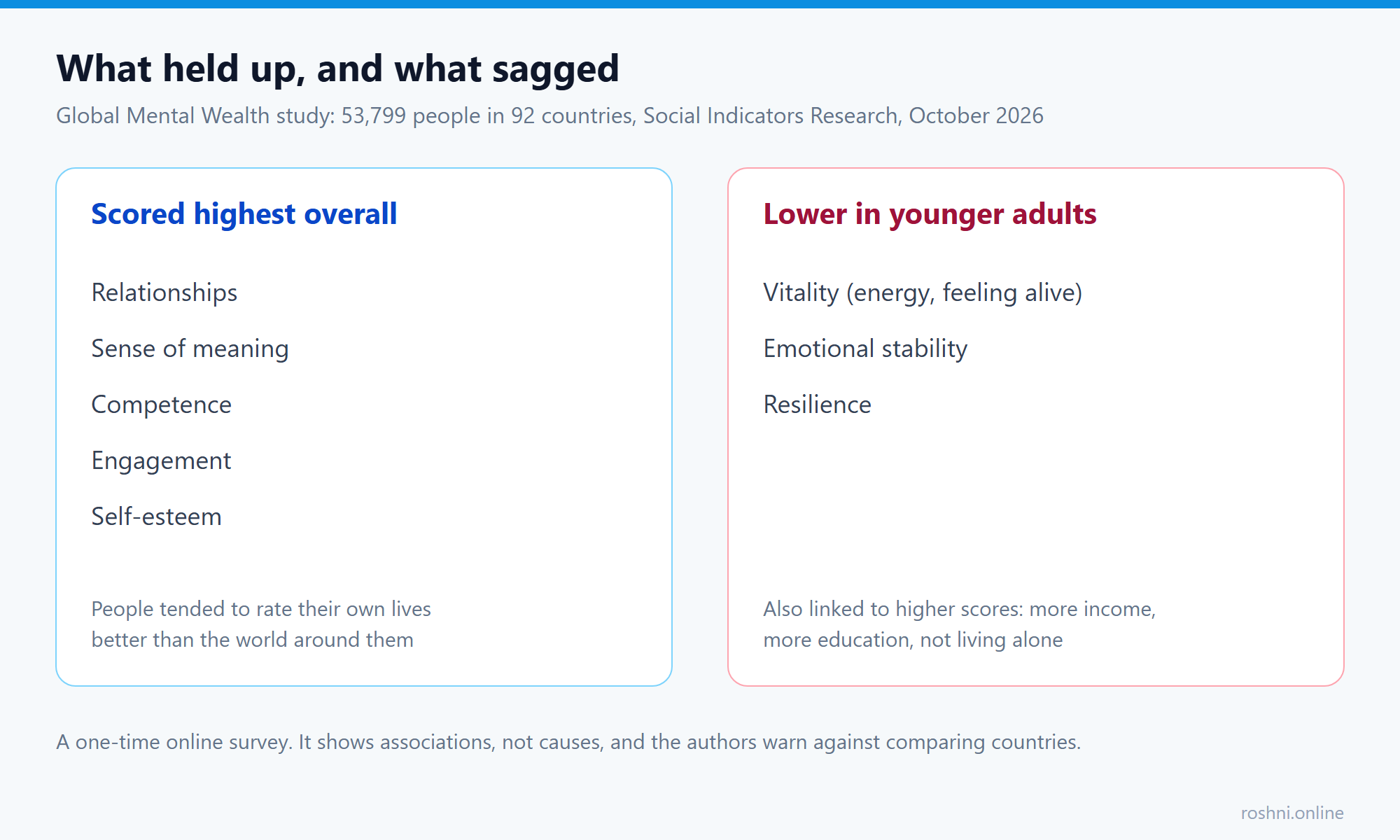
- Younger adults scored lower on vitality, emotional stability and resilience. In other words, less energy, more ups and downs, and less sense of being able to bounce back.
- Relationships and meaning held up. The highest-scoring dimensions were relationships, meaning, competence, engagement and self-esteem. People tended to feel better about their own lives than about the world around them.
- Money and education mattered, with no ceiling. Higher income went with better scores, and each extra level of education was linked to higher wellbeing.
- Living with others helped. People in larger households reported higher scores than people living alone, and hybrid workers scored better than fully remote ones.
Ruggeri described the results as “a flashing red light that entire populations are already struggling and feel their resilience is diminished here and now.”
What it can’t tell you
It’s a one-time survey, mostly completed online by people who chose to take part. That means it shows links, not causes. Living alone was associated with lower scores, but the study can’t say that living alone causes low mood. It might work the other way round, or something else might explain both.
The authors are open about the limits. They caution against comparing scores between countries, because people in different places may answer differently. They also suggest that some young people may have signed up precisely because they felt their mental health concerns weren’t being heard, while the oldest participants may have been the better connected and more energetic ones. They conclude that these factors can’t explain away the whole effect in such a large sample, but they’re good reasons not to read too much into any single number.
So treat it as a signal, not a verdict on you. If you’re a young adult and you feel worn down, the study doesn’t say that’s your fate. It says plenty of people feel it too, and that some things, like connection, seem to go with doing better.
Languishing, struggling, or in danger?
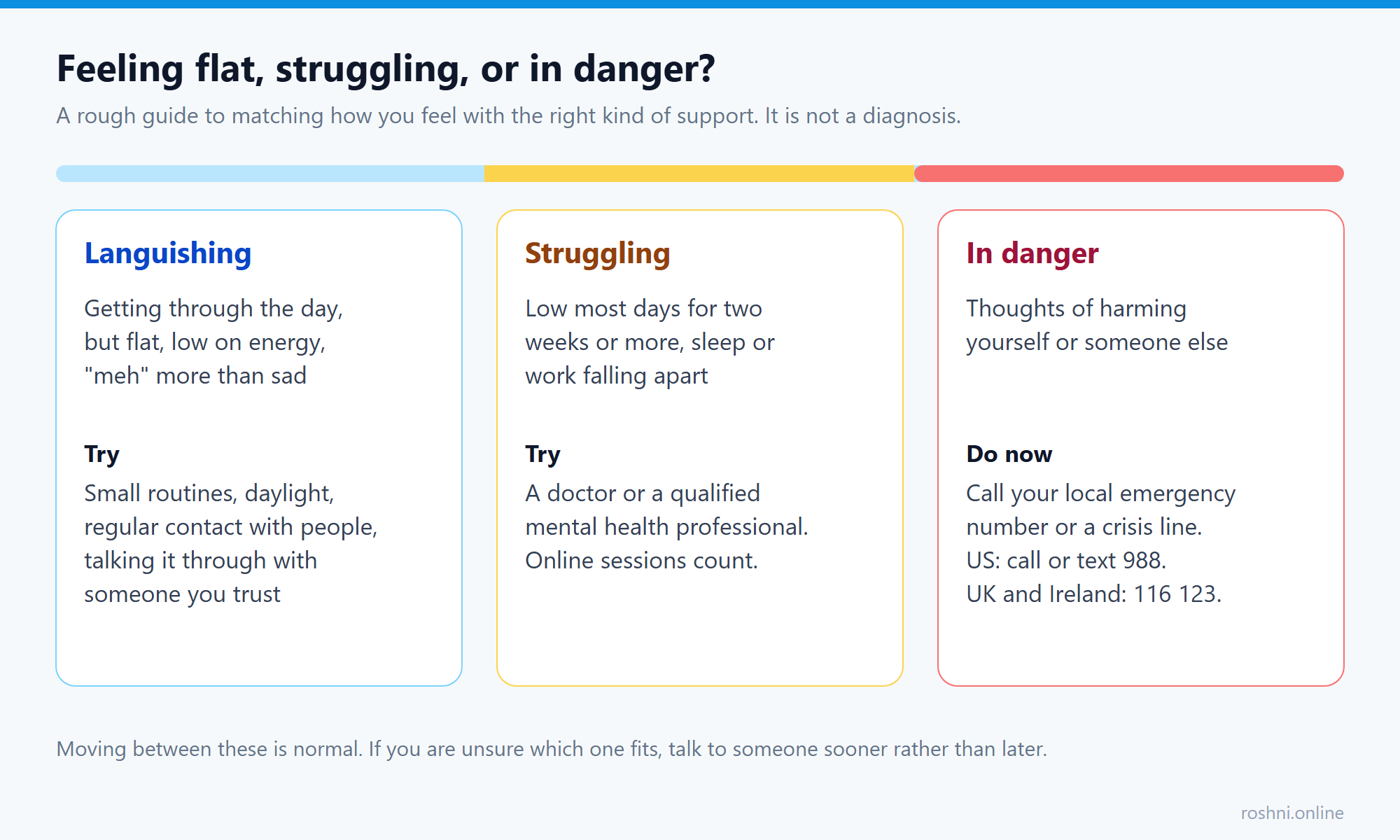
“Languishing” is a useful word because it names something many people feel but don’t mention. You’re not in crisis. You’re going to work or class, replying to messages, keeping things running. But it all feels a bit grey, and you can’t remember the last time you felt properly energised.
That’s different from depression, and different again from a crisis. Here’s a rough way to tell them apart and match each one with the right kind of help:
If you’re feeling flat
Small, regular things tend to help more than big plans. The study’s own findings point to a few of them, even if they can’t prove cause and effect:
- Stay in contact with people. If you live alone, build in regular calls, meals or walks with someone. Put them in your calendar so they actually happen.
- Look after your energy. Vitality was one of the weakest areas. Sleep at regular times, get some daylight, and move a little every day.
- Do something that uses your skills. Competence and engagement scored well. A task you’re good at, even a small one, can lift a flat day.
- Say it out loud. Talking it through with a friend, a family member or Roshni’s free AI assistant can help you make sense of what’s going on and decide whether you need more help.
If it’s lasted a while or is getting worse
If you’ve felt low most days for two weeks or more, or sleep, appetite, work or relationships are starting to slip, talk to a doctor or a qualified mental health professional. Online sessions are a real option. On Roshni you can book a session with a mental health professional by chat or video and see the cost before you book. Our guide to online mental health counseling explains how it works.
If you’re in danger
If you’re thinking about harming yourself or someone else, don’t wait and don’t rely on an app or a chatbot. Call your local emergency number or a crisis line now. In the US you can call or text 988. In the UK and Ireland you can call Samaritans on 116 123.
How Roshni can help
Roshni offers two kinds of mental health support. The free AI assistant is available 24/7 by text or voice, in any language, for talking things through and working out next steps. It’s private and separate from professional chat, and it’s designed to point you to a person when that’s what you need. We’ve written about how Roshni’s assistant knows when to hand you to a human.
When you want a professional, you can submit a question and get matched with a verified mental health professional for chat or a video session. If you’re not sure which you need, our guide to how online mental health support helps and where its limits are is a good place to start.
One small step for this week: pick one person you haven’t spoken to properly in a while and set a time to talk. It’s a modest thing, and it’s one of the few factors this huge study keeps pointing back to.
Frequently asked questions
What does languishing mean in mental health?
Languishing describes getting through life without really thriving: feeling flat, low on energy and unmotivated, without the symptoms of a mental illness. It isn’t a diagnosis, but it can affect how you feel and function.
What did the Global Mental Wealth study find?
The study of 53,799 people in 92 countries, published in Social Indicators Research in October 2026, found languishing mental health across many groups, especially younger adults and people in higher-income countries. Relationships and meaning scored best, while vitality, emotional stability and resilience were lower in younger adults.
Does living alone cause poor mental health?
The study can’t say. People in larger households reported higher wellbeing than people living alone, but because it was a one-time survey, it shows a link rather than a cause.
When should I get professional mental health support?
If you’ve felt low most days for two weeks or more, or your sleep, work or relationships are being affected, talk to a doctor or a qualified mental health professional. If you’re in danger, call your local emergency number or a crisis line straight away.
Can an AI assistant replace a therapist?
No. An AI assistant can help you talk things through and decide on next steps at any hour, but it isn’t a substitute for a qualified professional, and it’s never the right place to turn in a crisis.
Recent Comments